by Bruce Sylvester / Troubadour, Thursdays 2 – 4 pm
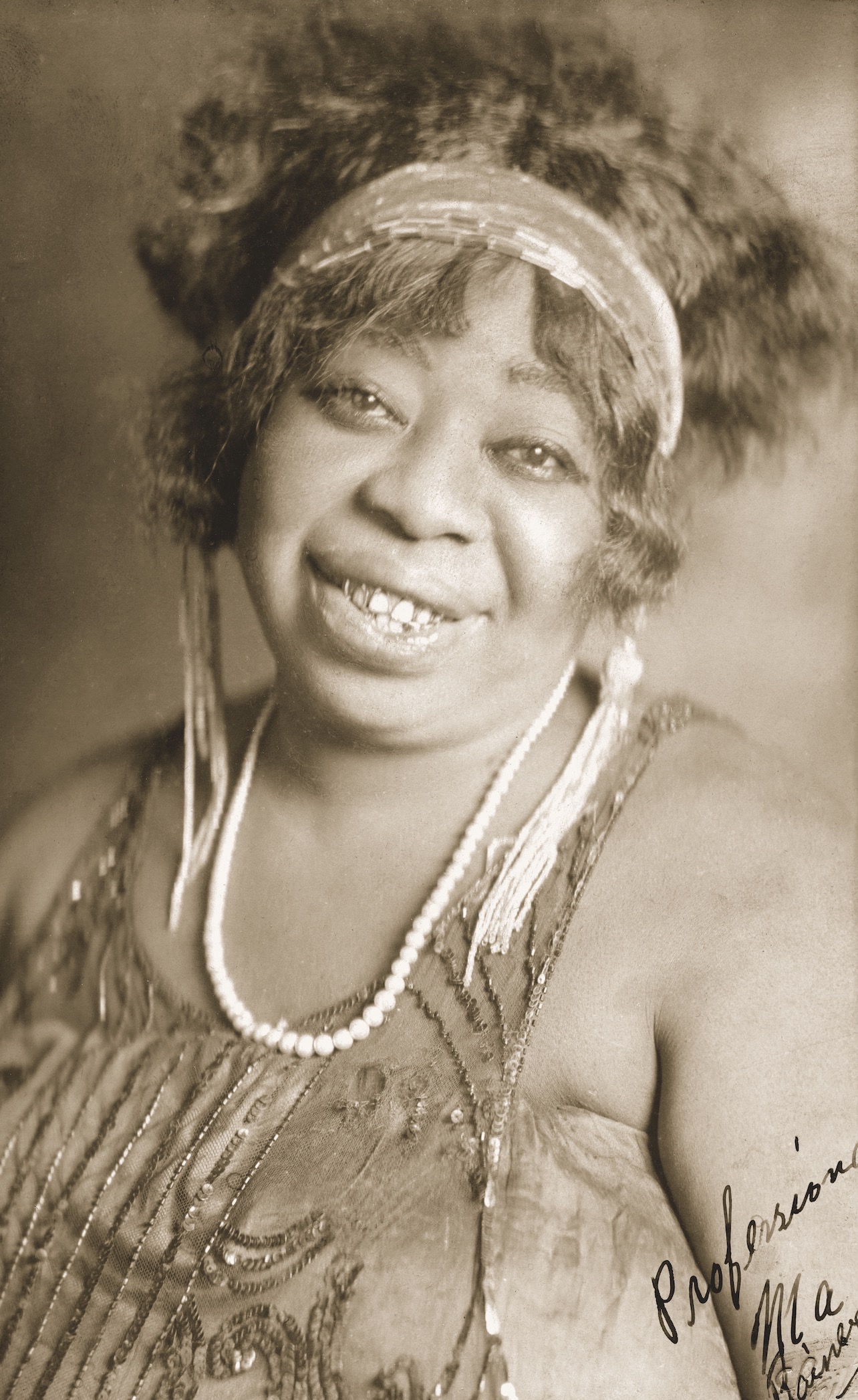
Yes, Bessie Smith is known as the empress of the blues, but her predecessor Ma Rainey was called the queen of the blues. Whereas Bessie was downhome regal, Ma was simply downhome, as we hear on authoritative five-CD, 118-track Mother of the Blues: The Complete Paramount Recordings 1923-1928 (Black Swan/George H. Buck Jazz Foundation).
Born around 1882 (sources vary), she grew up in Columbus, GA, and sang vaudeville in tent shows before discovering blues music in 1905. Since boundaries between musical genres weren’t an issue back then, her sidemen on records were a jazz who’s who: Louis Armstrong, Fletcher Henderson, Coleman Hawkins, Johnny Dodds. Pianist Tom Dorsey was hokum bluesman Georgia Tom and later became gospel’s influential Rev. Thomas A. Dorsey. Tampa Red’s heard too.
Blues lyrics could move around. “Frankie and Stagger Lee” cobbles together murder ballad “Frankie and Albert” with bad-man tale “Stagger Lee.” Rainey’s “Southern Blues” shares a stanza with Lead Belly’s “Western Plains.” “Lost Wandering Blues” has important lines in Blind Lemon Jefferson’s“Matchbox Blues” (“Matchbox” to Carl Perkins and later The Beatles). Here’s the original recording of “C.C. Rider” (aka “Easy Rider”), a song revamped in countless ways by Lead Belly, Chuck Willis, Lavern Baker, Elvis Presley, Ian & Sylvia, and Eric Burdon & the Animals among others.
Lesbian “Prove It on Me Blues” shows how frank early blues could be. She sings of murder threats and voodoo too. A century after she co-wrote it, “Sleep Talking Blues” is still good advice about not sabotaging a relationship.
Born Gertrude Pridgett, she became known as Ma Rainey after teaming up both musically and in business with her older husband, William “Pa” Rainey. She was no beauty but had a big, friendly face and, by many but not all accounts, was nice to deal with. She knew the importance of appearance with her clothes, gold teeth, and necklaces of gold coins. On stage, she might emerge from an enormous cabinet. “Ma Rainey’s Black Bottom,” a song here and the title of the fictionalized film starring Viola Davis, referred primarily to a dance she’d do.
Her recording career ended as the Great Depression neared. She returned to the lovely home she’d bought her family in Columbus and died of heart trouble in 1939. Younger blueswoman Memphis Minnie’s 1941 elegy to her is still on disc. Of course, blues preservationist Maria Muldaur has covered her. Odetta surely listened to her.
The box is mostly chronological with a few alternate takes. Audio quality was a challenge. Among the labels producing early blues, Paramount and Gennet had little concern for it – a problem for reissuing Ma Rainey’s and Blind Lemon Jefferson’s catalogs as well as early Alberta Hunter and Skip James sessions. The original masters are long gone so original 78 RPM platters had to be borrowed from serious collectors. The press notes relate: “Doug Benson oversaw detailed audio restoration, beginning with compiling the best surviving 78s of all 118 songs he could find. He then began a comprehensive remastering effort. In a few instances, he chose to leave in surface noise if removing it would have adversely affected the music. The decision was made to remaster rather than de-mix and remix the audio for two major reasons: one, that de-mixing software doesn’t work well on acoustical recordings, which make up about half of this set; and two, to be faithful to the original releases as they were presented at the time.” The sound here fluctuates but generally is as good or better than could reasonably be expected.
An accompanying 12”x12” 100-page paperback book has song lyrics, sessionography, and essays including detective work to separate fact from fiction in her legend. The abundant illustrations include ads, newspaper clippings, a marriage license application, and a photo of her Columbus home, which is now a blues museum.
Would Janis Joplin have been first in line to buy this box?