
by Jake Kassen / Can of Worms, alternating Mondays 7–8 am and 88 Rewound, Saturdays 12–2 pm
History
The last time WMBR overhauled a control room was in 1998. At that time, almost all music was played from CDs, records, cassettes, and minidiscs. Song logging was on paper. The station installed a Pacific Research & Engineering BMX III radio console, a top-of-the line broadcast mixer. Over the next 28 years, hundreds of WMBR DJs laid hands on it. More than a million songs have been aired from A Control, each with a button press and fader push.
By 2025, the equipment was worn, the carpet threadbare, and the ceiling dingy. The room was cramped for DJs and guests. The desk was suboptimal for laptops and the single DJ computer had been awkwardly retrofitted above the console. The room looked tired and keeping everything operational was increasingly difficult.
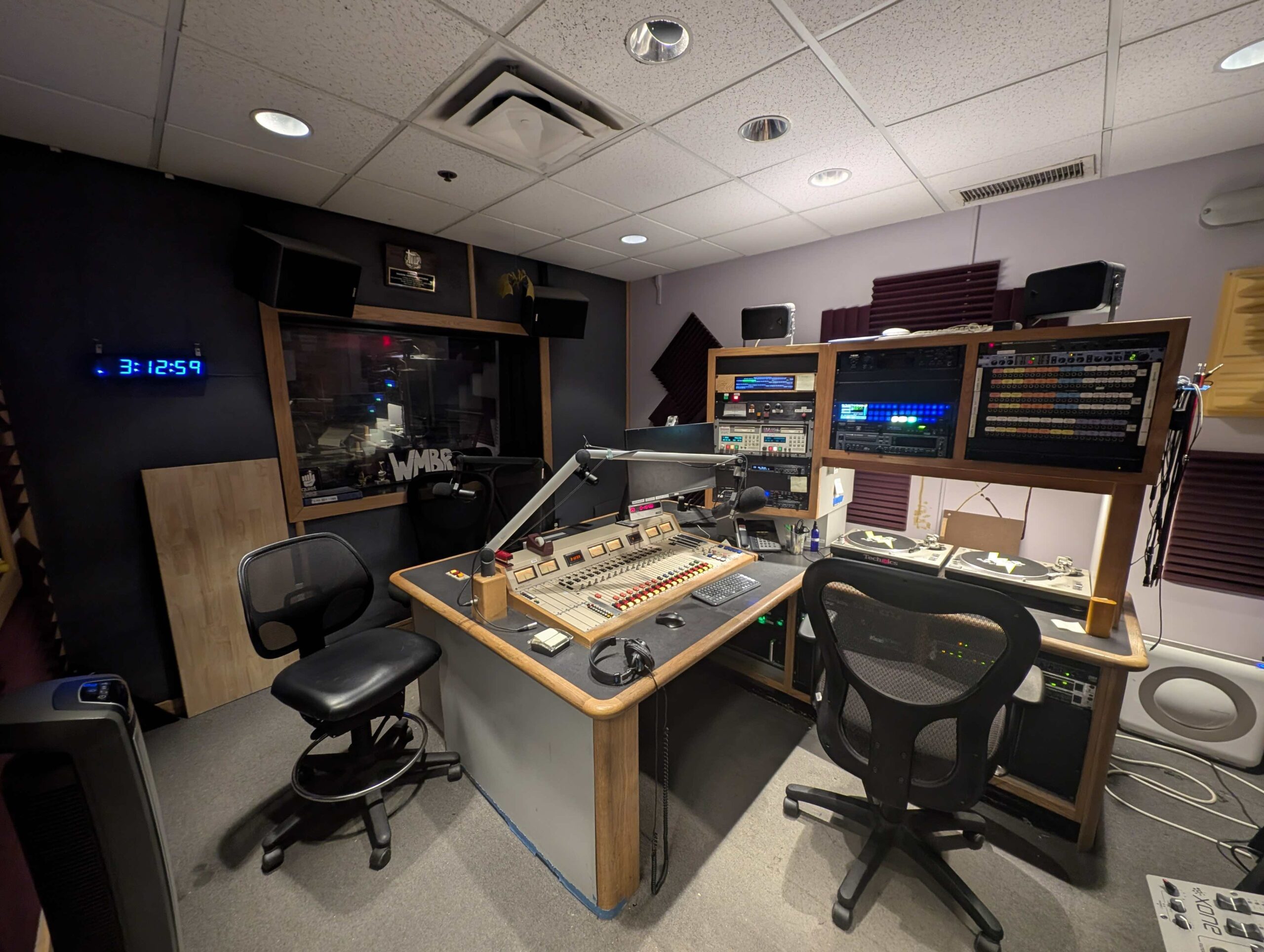
Control Room A before renovation
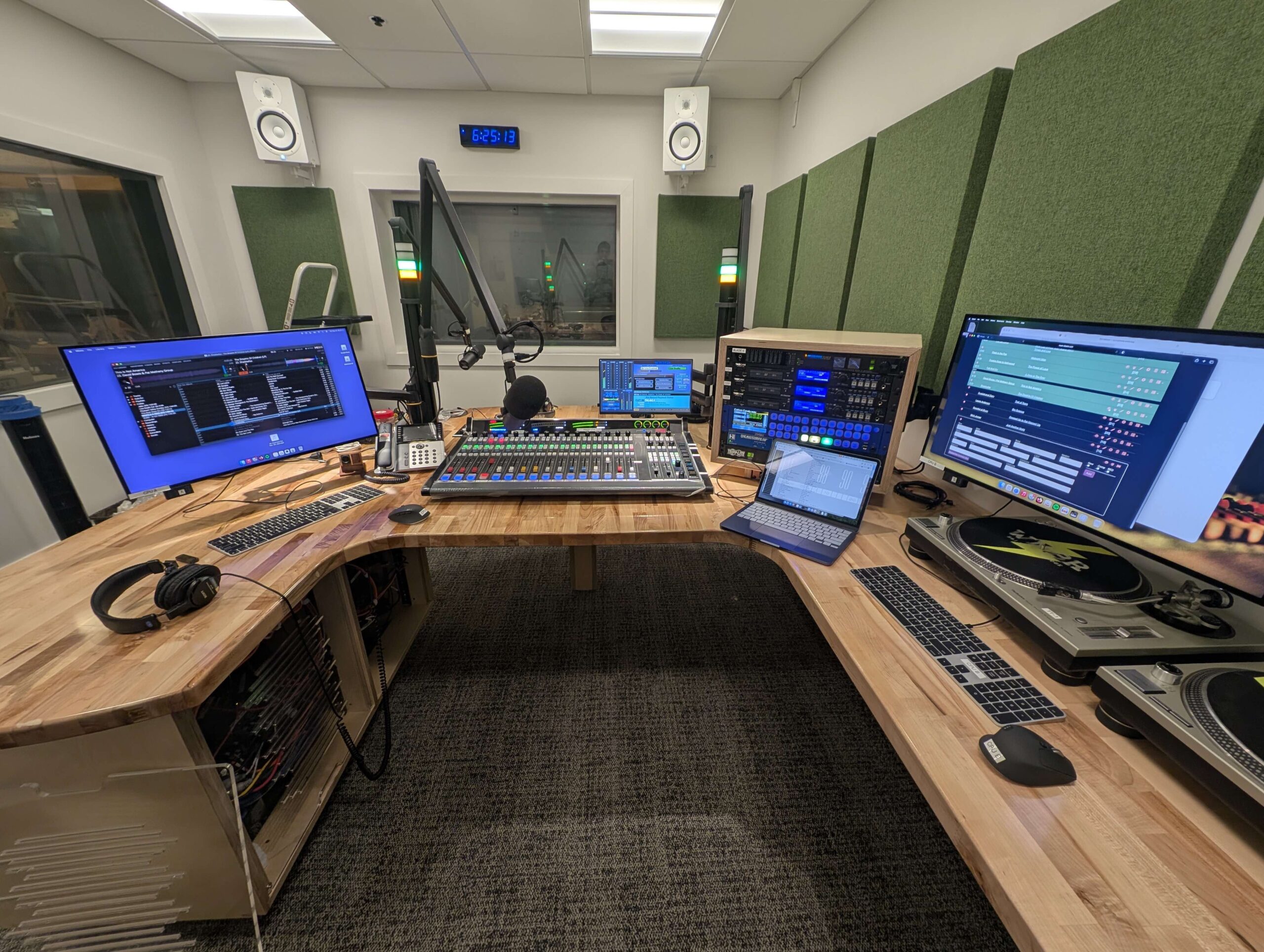
WMBR’s General Manager, James Rock, launched an initiative to completely overhaul this space, known as “A Control”. The Control Room would get new walls, new carpet, a new ceiling, and, most importantly, a new desk. The analog console would be replaced with a modern equivalent, utilizing an Audio over IP (AoIP) system that provides far more flexibility and features. No more patchbays. All audio devices would connect to “blades” that convert the signals to AES67 format and be routed via a dedicated network across the station.
WMBR is fiercely independent. Most college radio stations are wholly owned by their parent institution and usually under the quiet oversight of paid staff who manage the station, handle the daily upkeep, and outsource major technical changes as needed. This is not the case for WMBR, an institution that has always been autonomous and creative, right down to facility design.
Since WMBR founding in the early 1960s (then WTBS), MIT has provided the station with a suite in the basement of Walker Memorial building but little else. For the renovation, WMBR would need to hire MIT’s project managers, hire a carpenter to build a desk designed in-house, and directly purchase and commission all new equipment.
After deciding to update the control room, WMBR put out a call for new community members with the hope of adding some additional volunteer help with this and other projects. As a longtime listener and admirer of WMBR, I’m one of the people who responded.
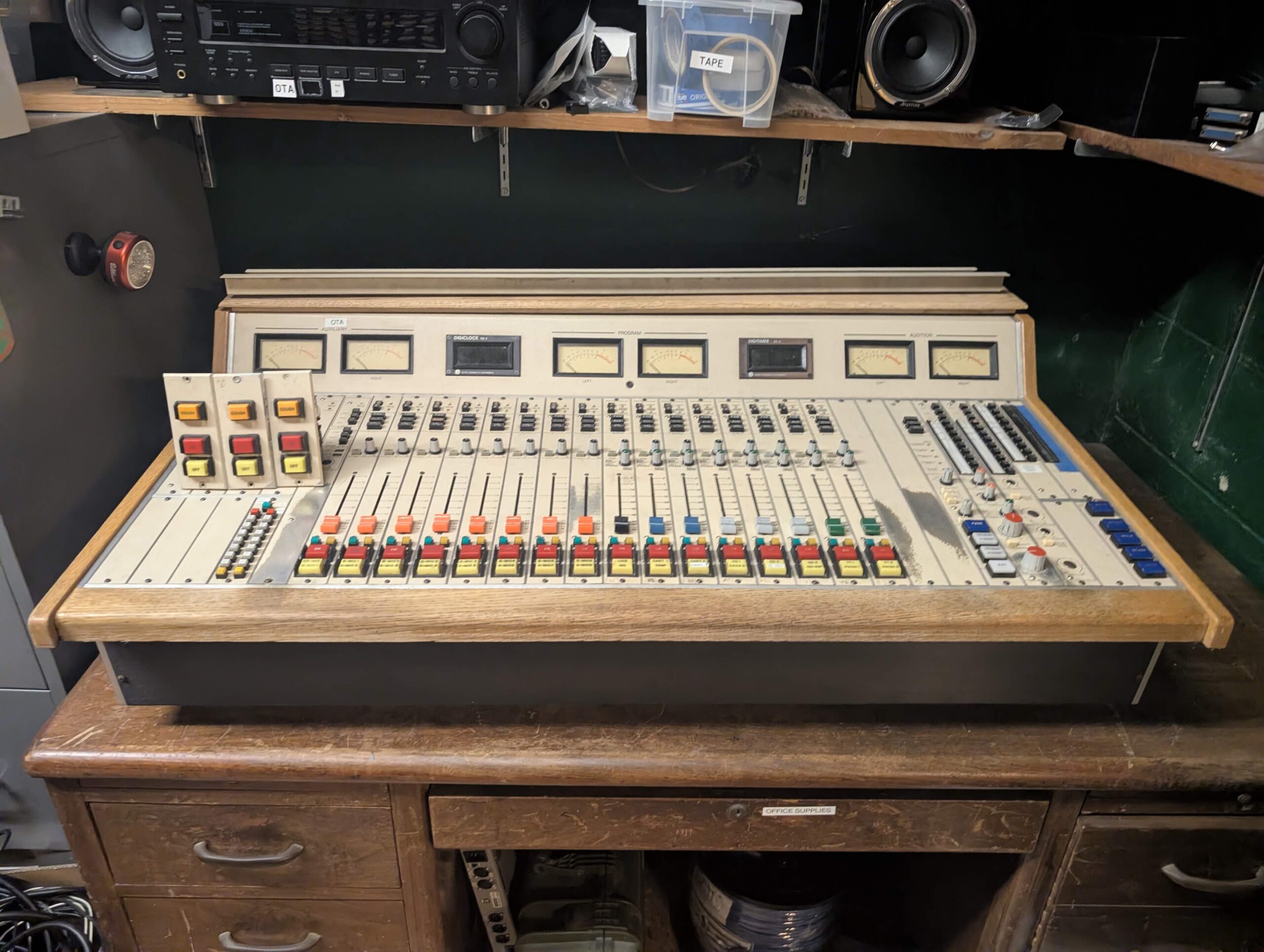
WMBR’s PR&E BMX III Console after being removed. 28 years of use!
Control Room Design
WMBR has roughly 90 different programs on the schedule, each with different preferences. Taking into account everyone’s requests yielded the following requirements:
- Three CD players, preferably ones that work. Must be within arm’s reach.
- Two turntables. Must be within arm’s reach
- Two computers for music playback and song logging. Must be within arm’s reach.
- USB-C connections for two laptops and related counter space. Must be within arm’s reach.
- One Cart machine. (Carts play the station IDs, PSA, show promos, etc.)
- XLR & RCA inputs for auxiliary equipment
- Generous physical space for up to three on-air guests
- ADA Compliance (ample clearances between desk and walls)
- Two lighting zones, each with adjustable brightness.
- Lots of rack space for equipment, easily accessible on both sides.
- Plenty of additional counter space. DJs like to spread out!
- Audio connection for the new telephone (WMBR had only recently replaced the 1A2 phones from the 1960s which had custom made audio integration hardware with the outgoing console.)
- It all has to fit into a roughly 10’ x 8’ room, leaving exposed windows into two other studios.
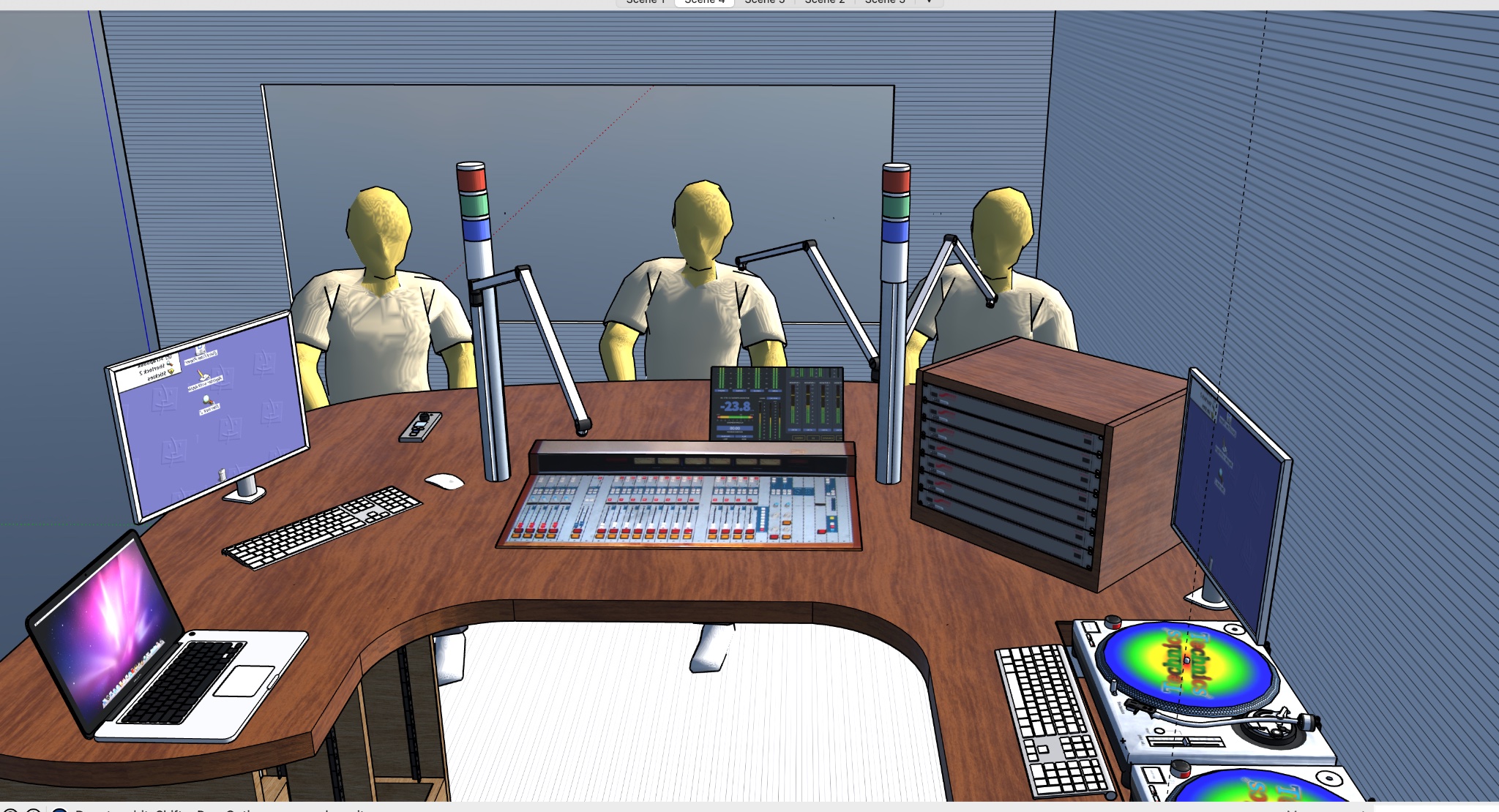
Rough rendering of proposed design
One thing not on the list is an “automation” system. All commercial radio stations and many non-profit stations use what’s known as automation, a system where some or all the programming is effectively controlled by a robot. A DJ or Programming Director pre-selects from a list of recordings and a computer runs the live broadcast. Often a host will record their mic segments in advance and these recordings get plugged into the playlist. Truly live radio is becoming uncommon. Many commercial stations have no local staff and even public radio and better-funded college stations are fully automated for large parts of the day.
With full automation, broadcast studios often consist of nothing more than a console, a computer, and some microphones. As WMBR shuns automation, we require a multitude of traditional playback devices, all readily accessible by the DJs. WMBR has an enormous record library with roughly 100,000 CDs and records going back 60+ years and will always need a way to air these recordings live.
Physical Construction
The new equipment was selected in late summer and started arriving in September 2025. We commandeered the adjacent performance space, A Studio, and assembled the new equipment on folding tables. The intention was primarily to configure and test, not to use extensively for live broadcasting. But out of necessity, the hastily assembled, ragtag setup would ultimately become a heavily used control room for many months.
Shortly after Christmas in 2025, James (WMBR GM), Will (Tech Director), and myself yanked out all the old equipment from Control Room A. The expected timeline was for the new Control Room to open mid-February.
In early January, a contractor began the physical renovation in ernest. A disused door into the station’s repair shop was removed and covered, a fabric wall was replaced with more durable drywall, new lighting installed, and the space was painted. The process went quickly and we seemed to be on track.
Meanwhile, the station hired a carpenter to build the custom desk. Warning signs quickly appeared, such as the shop waiting too long to source the butcherblock stock for a countertop. The initial completion deadline was missed. When the desk was finally delivered, several construction problems were evident. The desk was returned to the workshop and it would be almost two months before it returned to the station.
By April, the desk finally returned. Former WMBR DJ (and master carpenter) Doug Gesler of “Lost Highway” fame returned to the station to finish some details skipped by the original millworkers.
Finally, by mid-May, the physical renovations were complete. The week preceding Memorial Day was the big install. Piece by piece, the temp studio got relocated to its new home.
As large of a project as this was, it’s nothing compared to the previous renovation back in 1998. At that time, every device had two wires (analog stereo pair) run to a patch bay and from the patch to the underside of the large console in the desk. Every wire needed a connector (XLR, RCA, etc) soldered to one end and crimped to a proprietary connector on the other.
In the new control room, analog and digital signals are carried over Cat6 cable with RJ45 terminations. Pre-made Female RJ45 to XLR adapters are used to save time. There’s no physical patch bay as input signals are converted to AES67 data streams and move via multicast networking to every endpoint simultaneously. In effect, every destination receives every source – a virtual router (database) indicates which one should be decoded back to an analog or AES/EBU endpoint.
I don’t think such a system would have been inconceivable to the students who first moved into WMBR’s home in the Walker Memorial building some 60 years ago, or to the station members who last renovated the room in 1998. But they certainly would have been envious of a system that needs only 100 connections instead of several hundred.
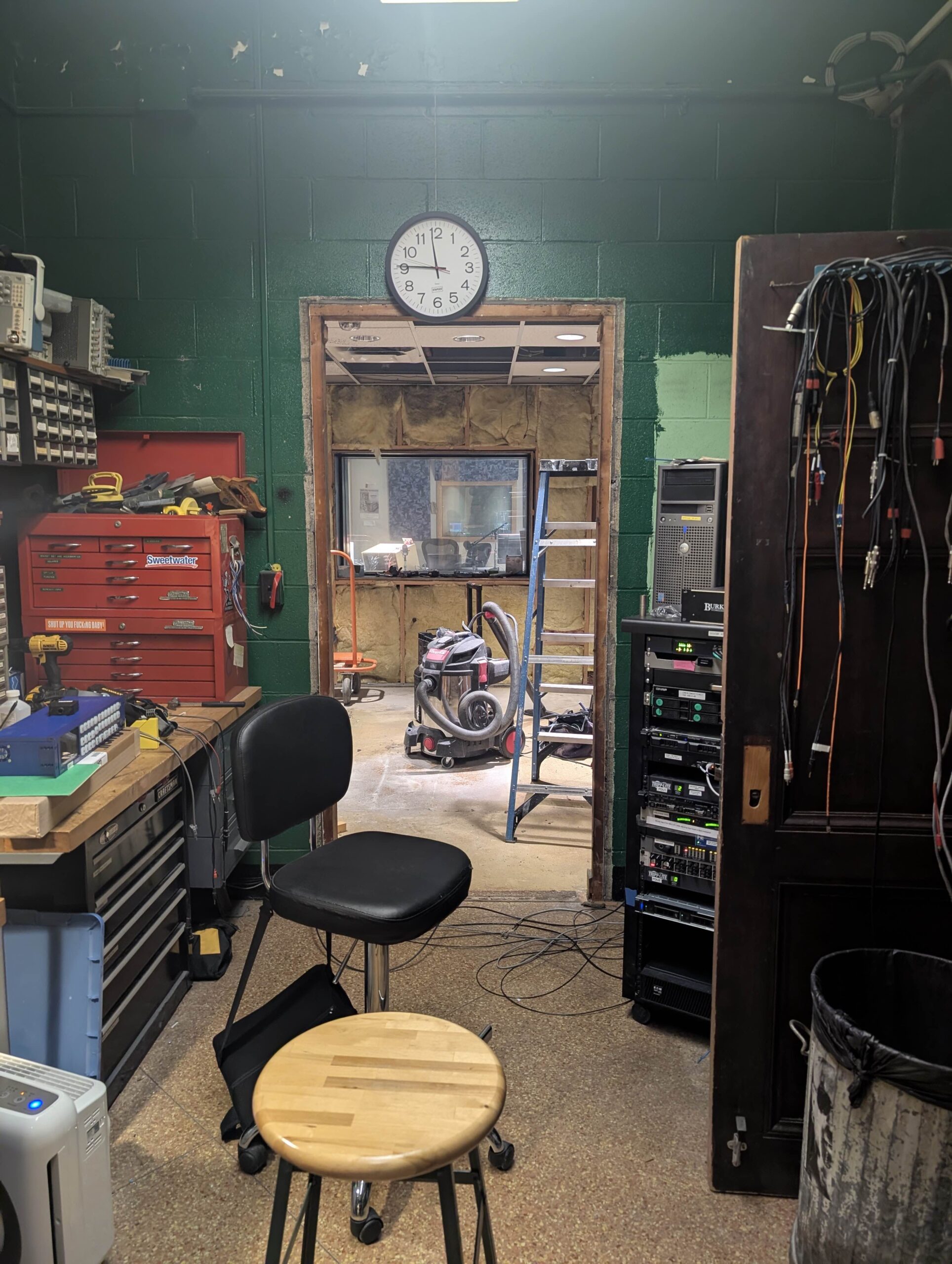
Looking through WMBR’s equipment shop, into the new Control Room A, through the window into Performance Studio A (Live Music), and through another window into Control Room C. This doorway is now walled off.
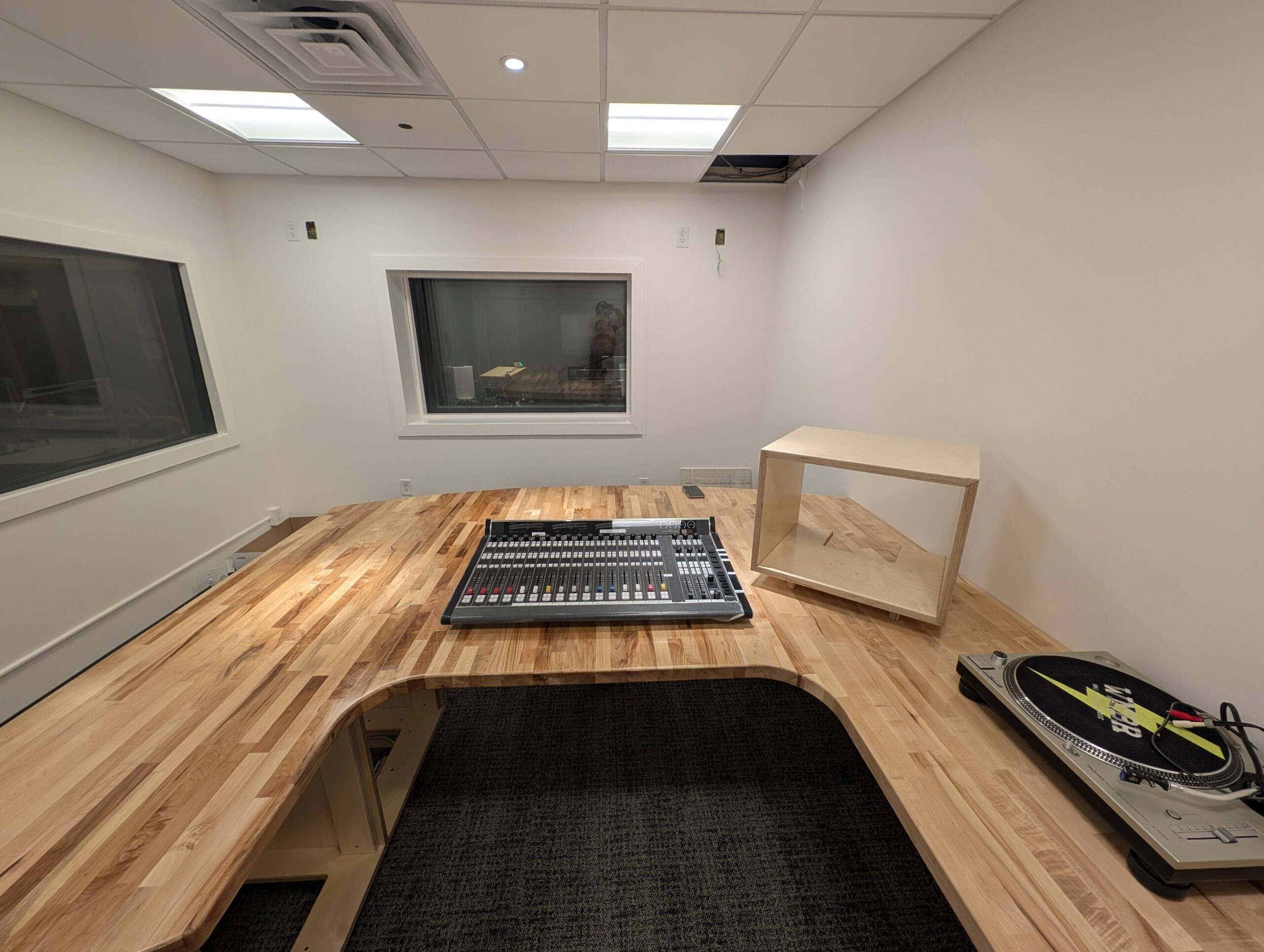
“Sanity Testing” the placement of equipment on desk shortly after installation.
New Desk and equipment from the DJ’s perspective
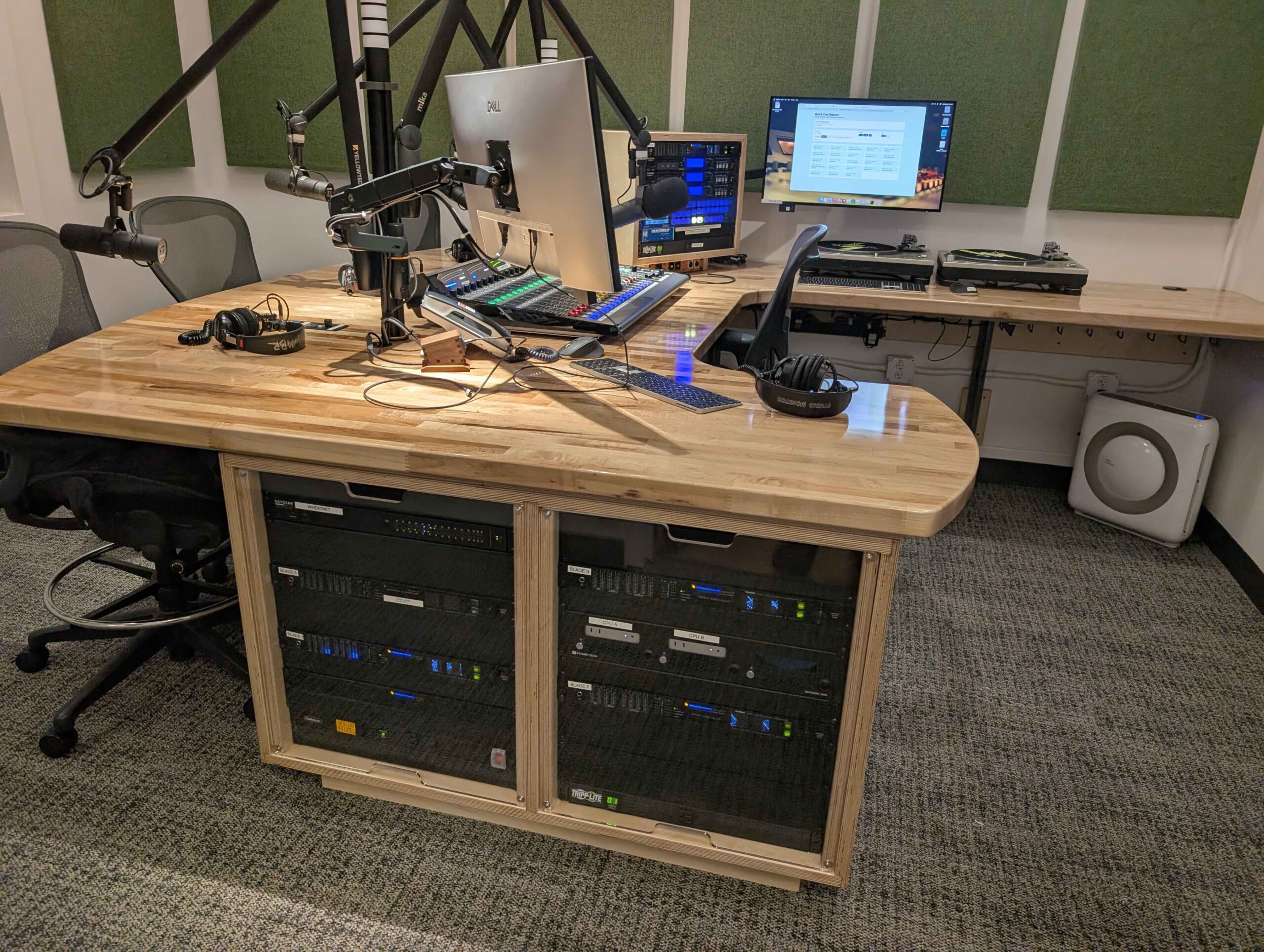
Side of desk with built-in equipment racks. Mic arms and monitors are easy to reposition as desired.
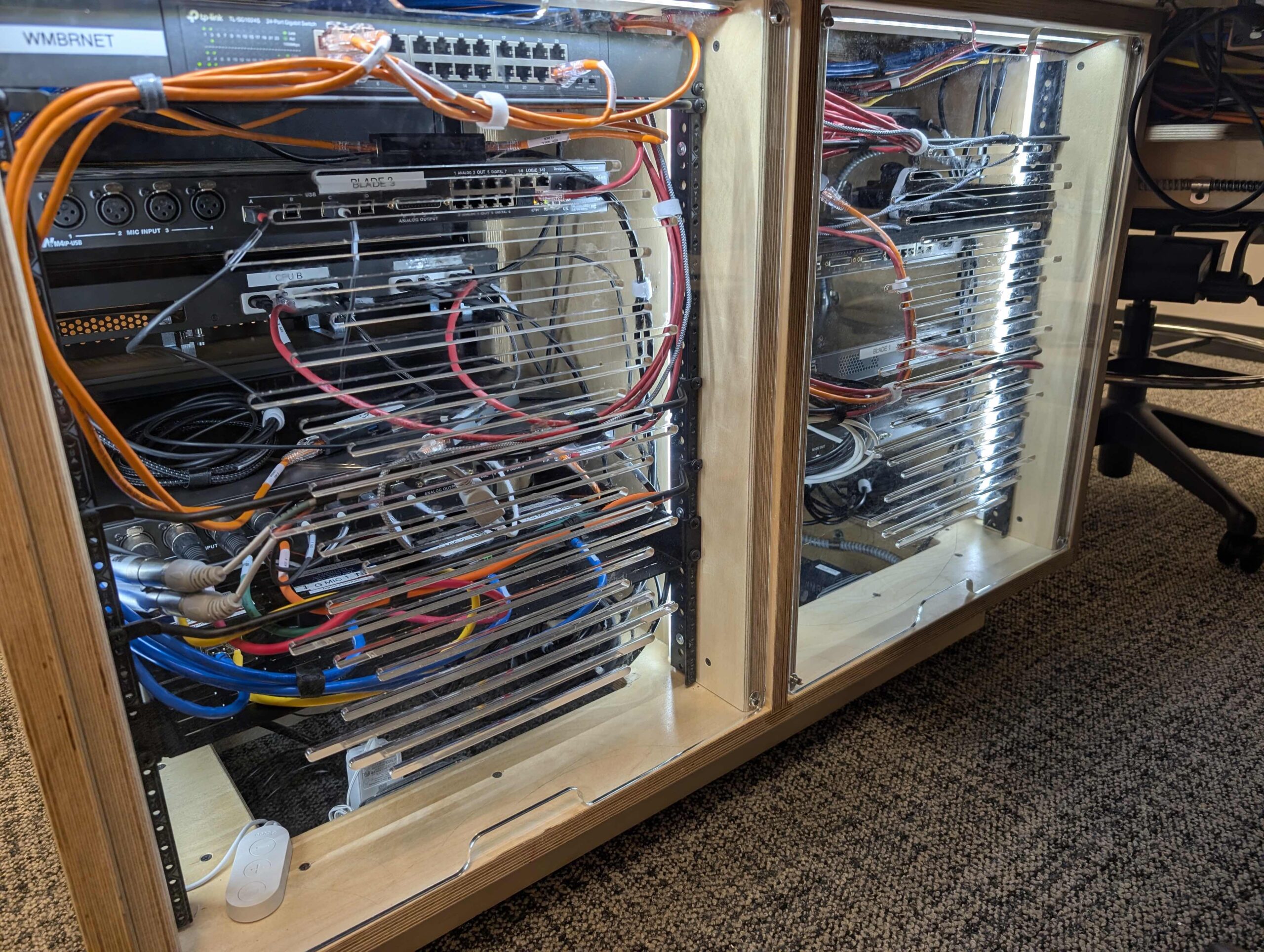
Rear of the under-desk equipment rack. Lighting was added to help servicing. Protective panels are acrylic with venting slots and attached via magnets for quick access.
It All Comes Crashing Down
The station hosted a small grand opening ribbon cutting in May, complete with a cake. (Not to be eaten in the new control room!) And for the next few weeks DJs started to get settled in the new space.
And then, late on Friday evening of July 18, “A control underwent unexpected spontaneous disassembly” in the words of WMBR’s Technical Director. The drop ceiling dropped. Almost everything on the desk was damaged, as well as the desk that had taken so long to complete.
The cause of the failure was a steam pump that failed elsewhere in the basement of the Walker Memorial building, outside of WMBR’s suite. The basement became hot and humid and century old ductwork brought this humid air into WMBR’s space. WMBR’s fairly new air conditioning was able to keep the space cool. Too cold, in fact. Condensation formed on the ducts and pipes in the ceiling and dripped onto the ceiling tiles. The drop ceiling had been inadequately attached when it was installed in the 1990s. While that hadn’t been a problem for the past 30 years, the increasingly water logged ceiling tiles made the overall drop ceiling so heavy that the anchors gave out, introducing the grid, lighting, and ductwork to the new desk and carpet.
Thankfully, the room was unoccupied and no one was hurt. (Ductwork in other parts of the station also fell overnight when the station was unoccupied.)
And thus started renovation Part II. Once again, WMBR purchased new equipment. The ceiling was eventually replaced by MIT. WMBR staff fixed and repainted the walls. The once pristine desk now has battle scars.
After a restoration and many agonizing delays, Control Room A resumed broadcasting on Halloween 2026.
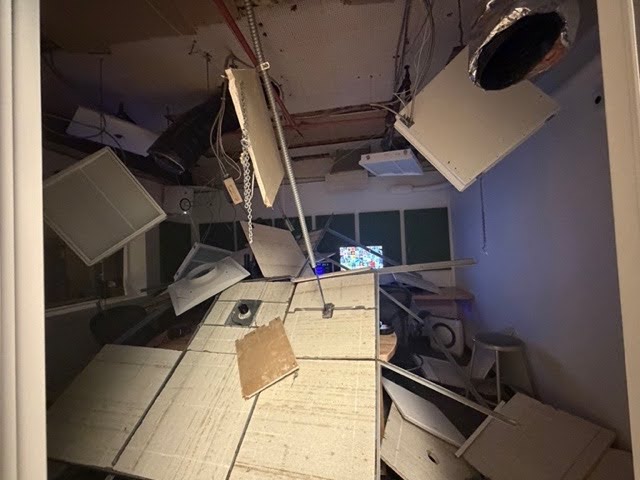
The marriage of the ceiling and desk
Final Thoughts
WMBR now has one of the most technically modern control rooms in greater Boston, equal or more capable than our commercial radio counterparts and public radio outlets.
This project has added another chapter to WMBR’s long and colorful history. Will the renovated A Control last another 28 years? Stay tuned.
Renovated Space Highlights:
Laser Cut mounting brackets: WMBR’s Technical Director (Will) makes some classy custom brackets and panels out of maple and walnut hardwood.
MacOS Remote Start Integration: Many DJs rely heavily on computer playback sources. At many stations, they have dedicated playback applications integrated with their console (see automation discussion above) but at WMBR, we support everything. Creative solutions have been created to allow almost any application to start playing when the DJ turns on the corresponding channel on the console.
WMBR DJ Dashboard: A screen above the consoles shows DJs all sorts of station info: FM Transmitter parameters, The status of the “backup” playback, weather, RDS data (The text that appears on car radios), and incoming text messages.
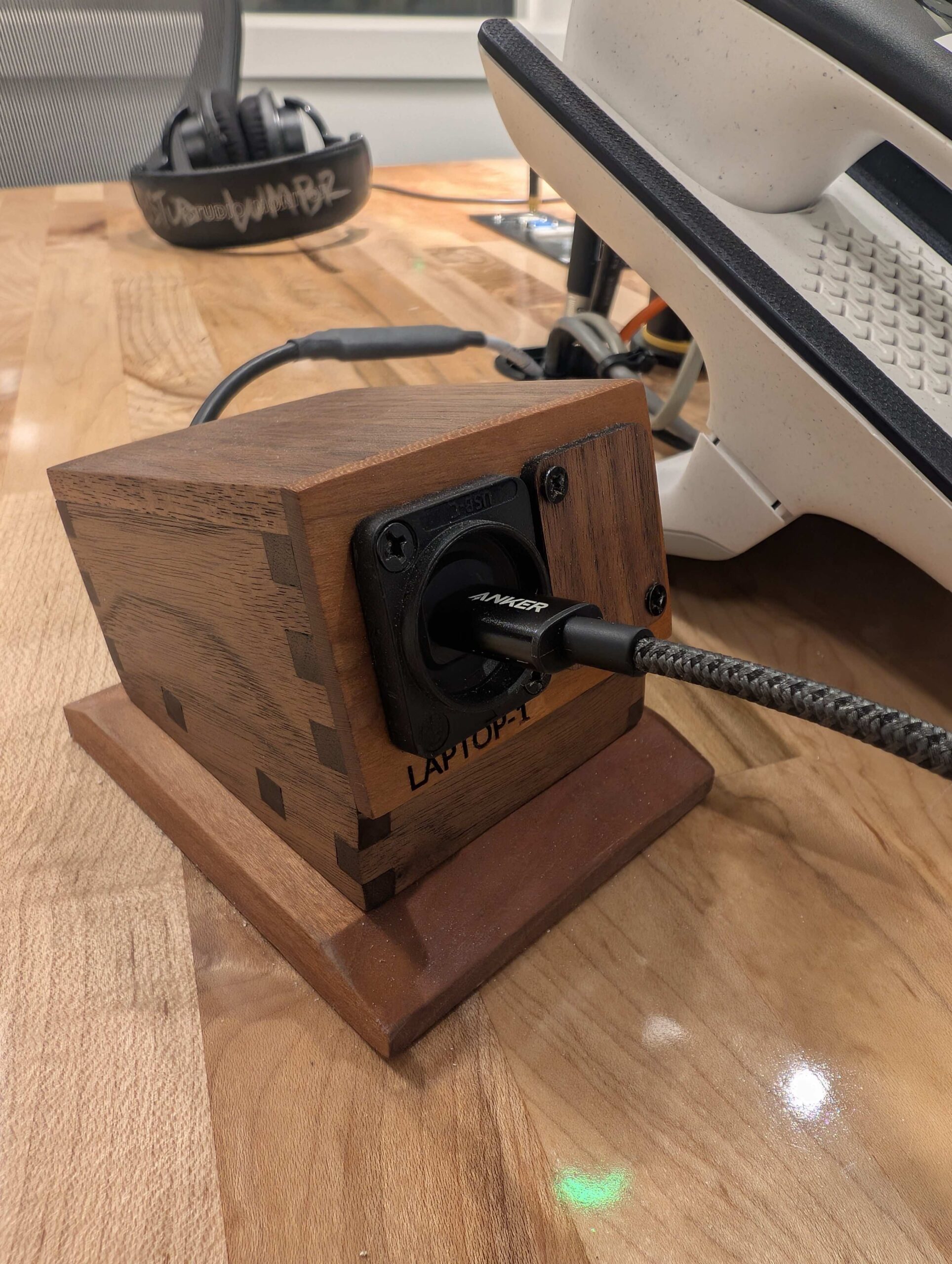
Laser cut maple turrets, courtesy of Will
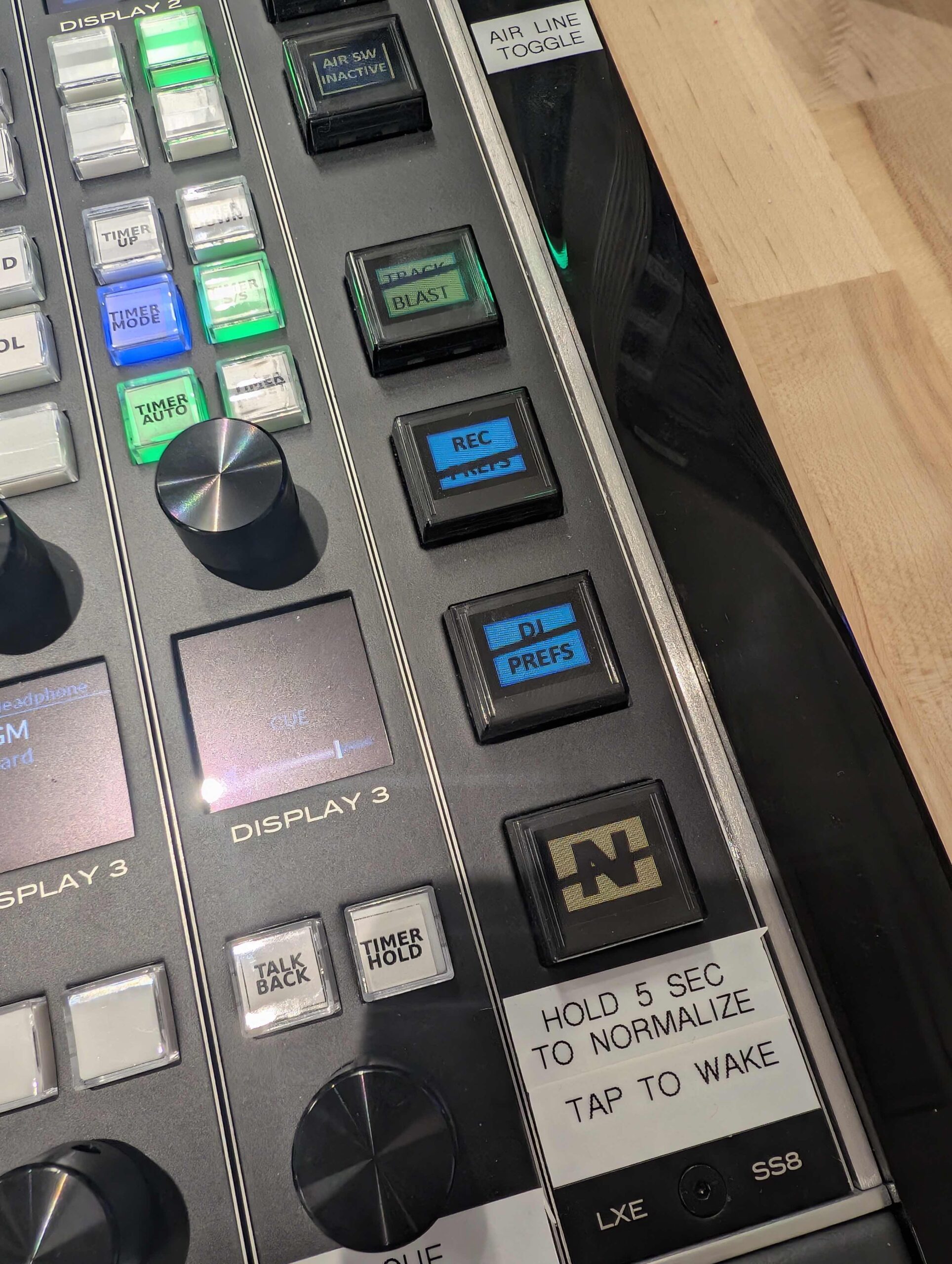
Controls on the console
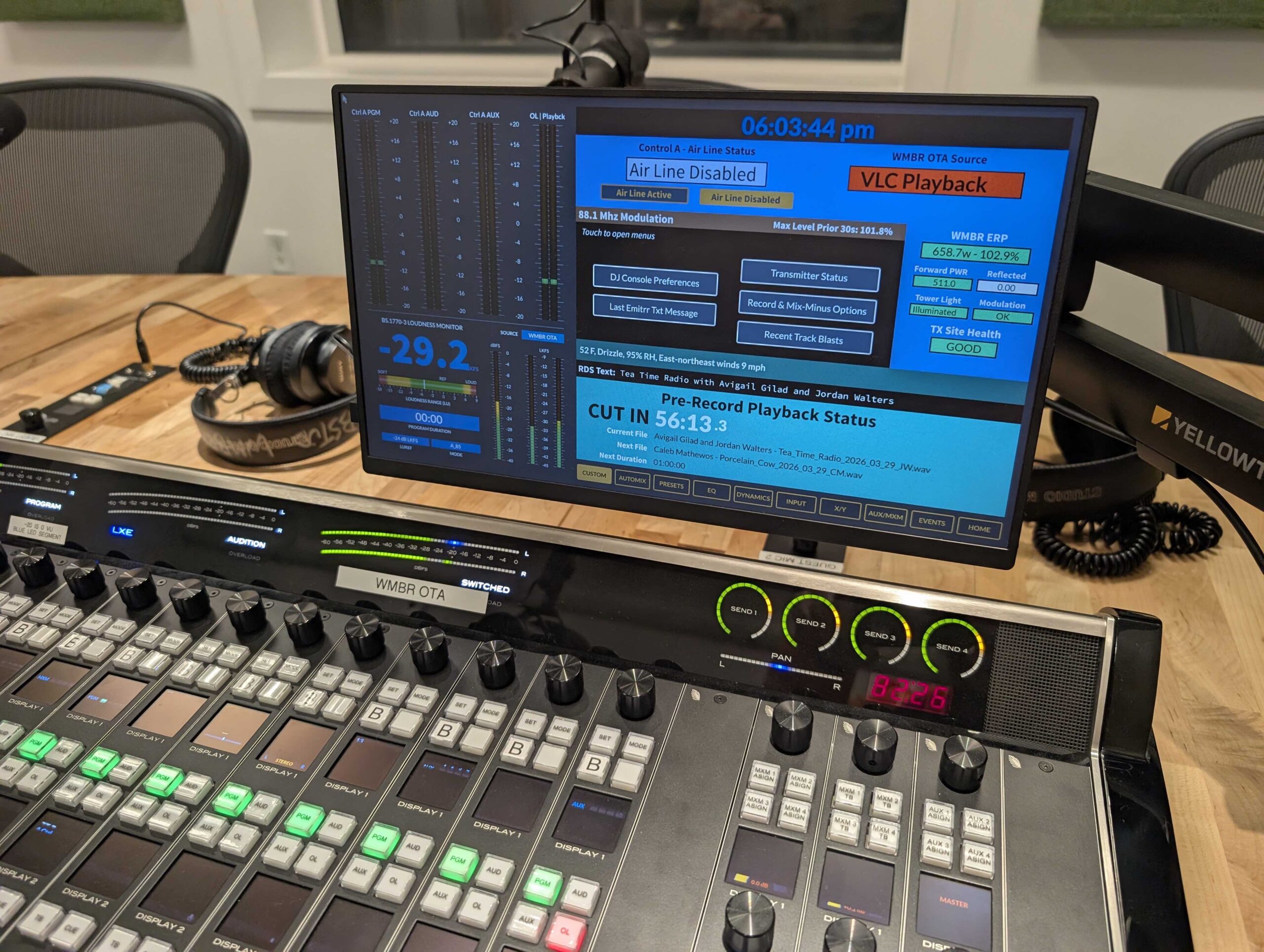
The DJ Dashboard
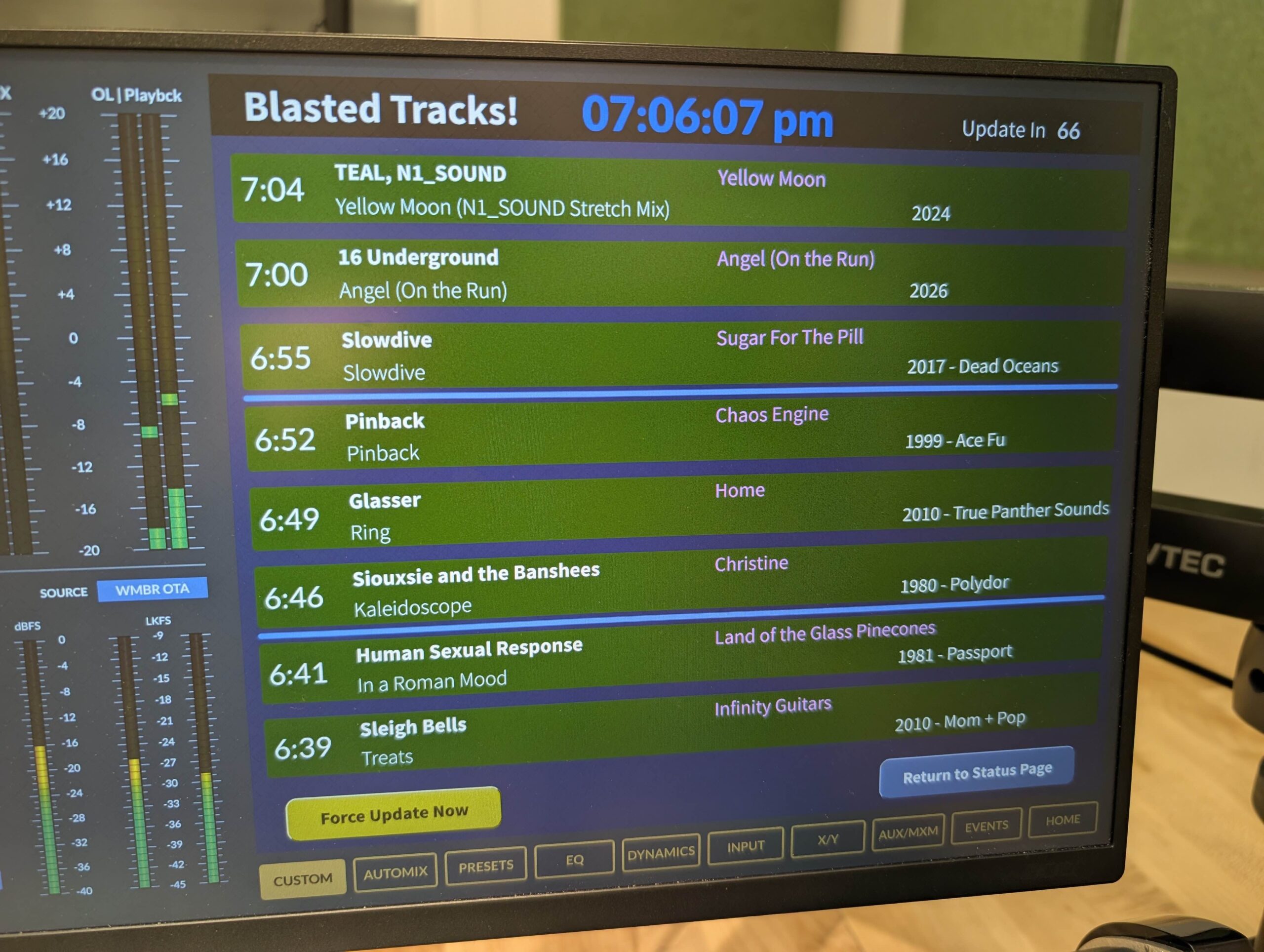
Recently played music screen for DJs